
Lyon County Arrest Records and Court Charges
Arrest records and court charge records are related, but they are not the same record. The arrest side comes from the agency that took the person into custody and from the jail or custody-status system. It may identify the person arrested, the arresting agency, custody status, the detention facility, booking activity, and whether the person is still held. In Lyon County, the Detention Center and Kansas VINE are the verified custody-status route, while the Sheriff's Office remains the local law enforcement contact for records requests and detention questions.
The court charge record begins when a prosecutor files a formal charge or when a municipal citation is filed in the city court. For Lyon County District Court criminal matters, the charging path runs through the District Court and the Lyon County Attorney. For Emporia ordinance, traffic, and many adult misdemeanor matters, the charge may be handled in Emporia Municipal Court. The full criminal case later adds pleas, motions, trial settings, disposition, sentence, probation, restitution, and appeal history. For booking and custody detail, use the Lyon County inmate records page. For the full case file, use criminal court records.
The Emporia Municipal Court process page is a useful local source because it explains that a complaint or traffic citation must be filed before a person can be brought to trial. That is the point where an arrest, ticket, or police event turns into a charge tracked by a court. The image below shows the municipal court process source used for city charge workflow research.
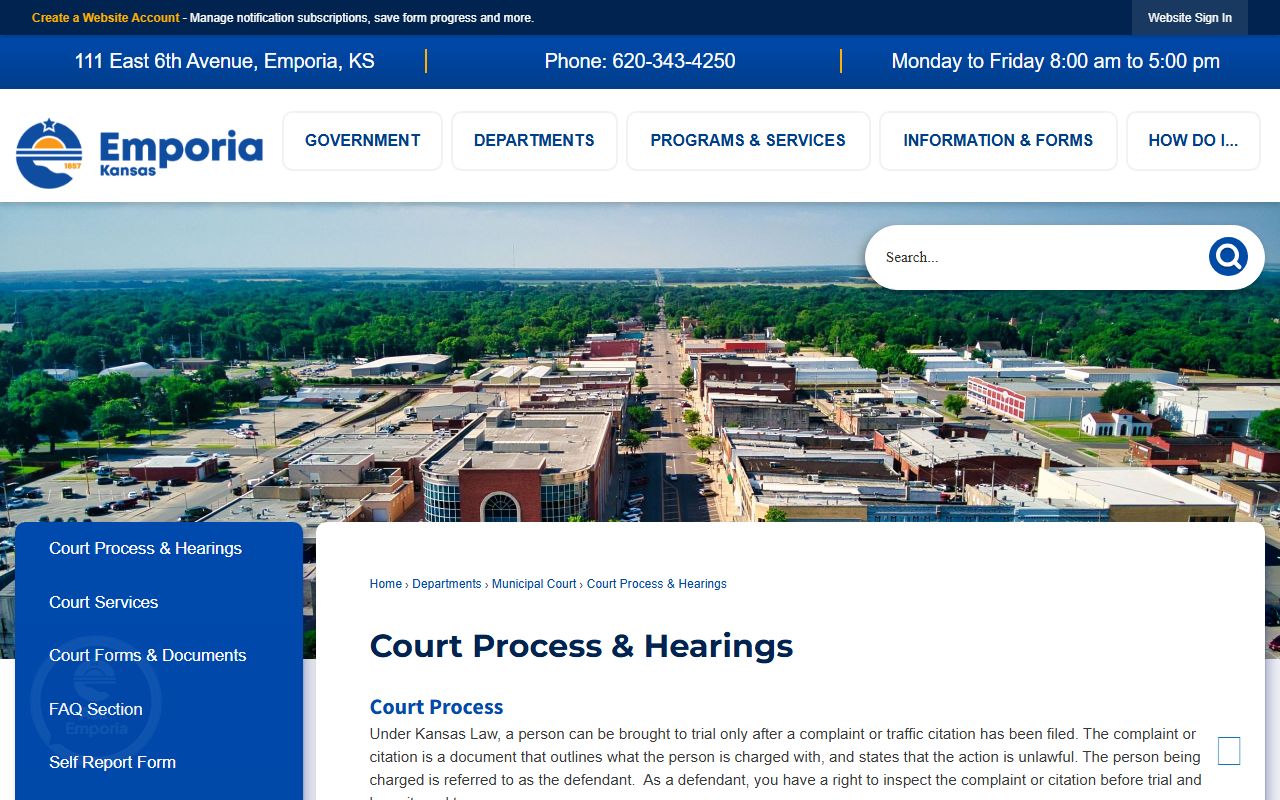
That local distinction matters because district criminal charges, municipal citations, and jail custody status can update on different systems and at different times.
How Lyon Charges Begin
After an arrest, the first public clue may be custody status. Custody is not proof that a court case has been filed. A court charge record usually appears when the prosecutor or city attorney files a charging paper with the clerk. The County Attorney prosecutes state criminal offenses in Lyon County. The County Attorney page lists Amy Aranda as County Attorney and gives the office phone as 620-341-3263. The office mission focuses on prosecuting people charged with criminal offenses while seeking truth and a just result.
The District Court criminal clerk contacts are cr1clerk@5thjd.org and cr2clerk@5thjd.org. District criminal records can include a complaint or information, warrants after execution, bond entries, counsel appointment, preliminary hearing events, arraignment, pleas, motions, trial settings, dispositions, sentencing, probation, restitution, and financial obligations. Municipal charges are separate. Emporia Municipal Court handles adult misdemeanors occurring in Emporia, with some exceptions, and tickets written by Emporia Police, ESU Campus Police, Emporia Code Enforcement, Planning and Zoning, Animal Control, and parking officers.
The Emporia Municipal Court Services page supports the local charge discussion because municipal probation, diversion, and supervision can follow a city charge. It is not a District Court criminal file, but it is a local record path for some post-charge obligations.
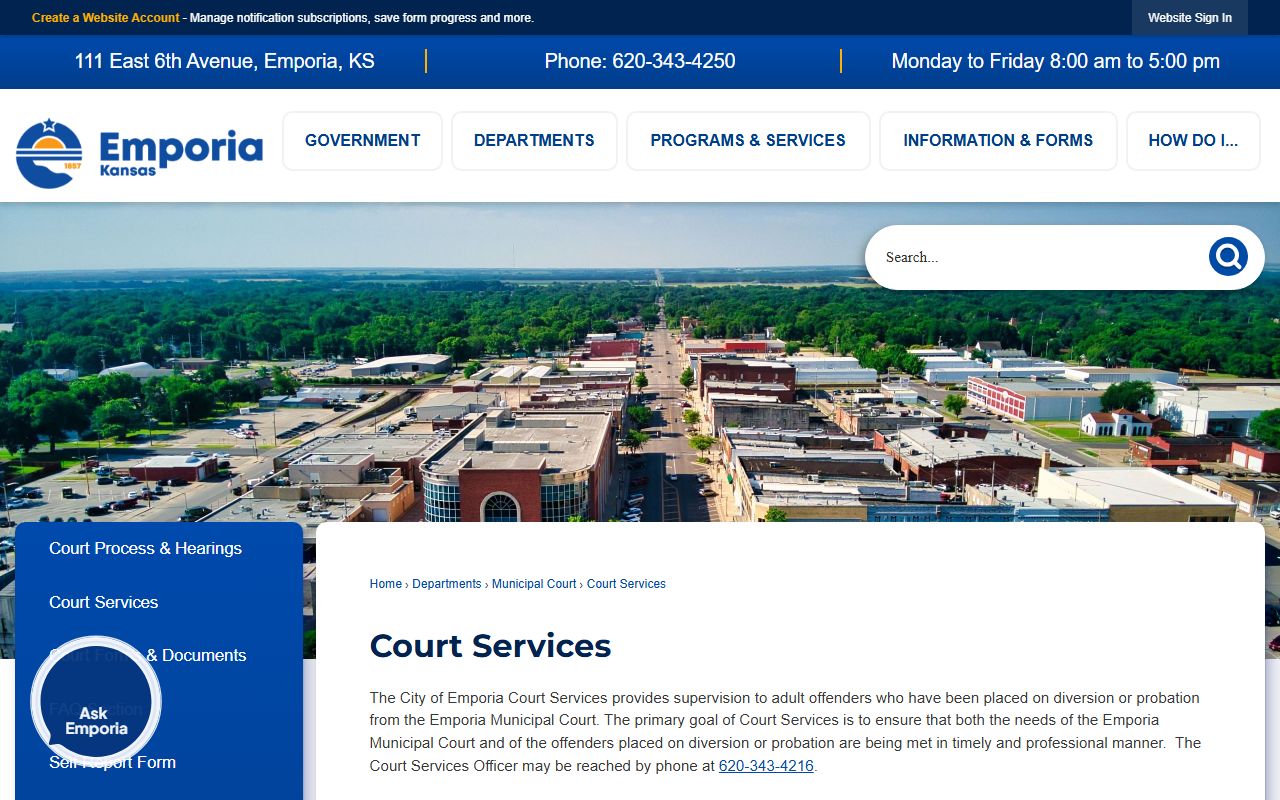
When the same incident involves both custody and prosecution, the safer search method is to check the jail or VINE for custody status, then check the correct court for charge filing and hearing activity.
Charging Documents After Arrest
A court charge record is built around the paper that starts or states the accusation. Kansas and local records may use different labels depending on case type and court. A complaint is a charging or initiating document alleging facts and legal basis. An information is the prosecutor's formal criminal charging document. An indictment is tied to a grand jury process and is less common for routine county searches. A citation can also work as a charging notice, especially for traffic or ordinance matters.
| Document | Who Files It | Local Use | What To Read |
|---|---|---|---|
| Complaint | Prosecutor or authorized filer | Criminal or municipal cases | Alleged facts, offense, statute or ordinance, defendant, court |
| Information | Prosecutor | District criminal charges | Formal charge list, severity, counts, case number |
| Indictment | Grand jury | Uncommon in routine local lookup | Grand jury accusation, counts, court, accused party |
The Emporia Municipal Court forms page is relevant because it groups local forms tied to municipal cases, including discovery, diversion, expungement, motions to reschedule, and fines or reinstatement packets.
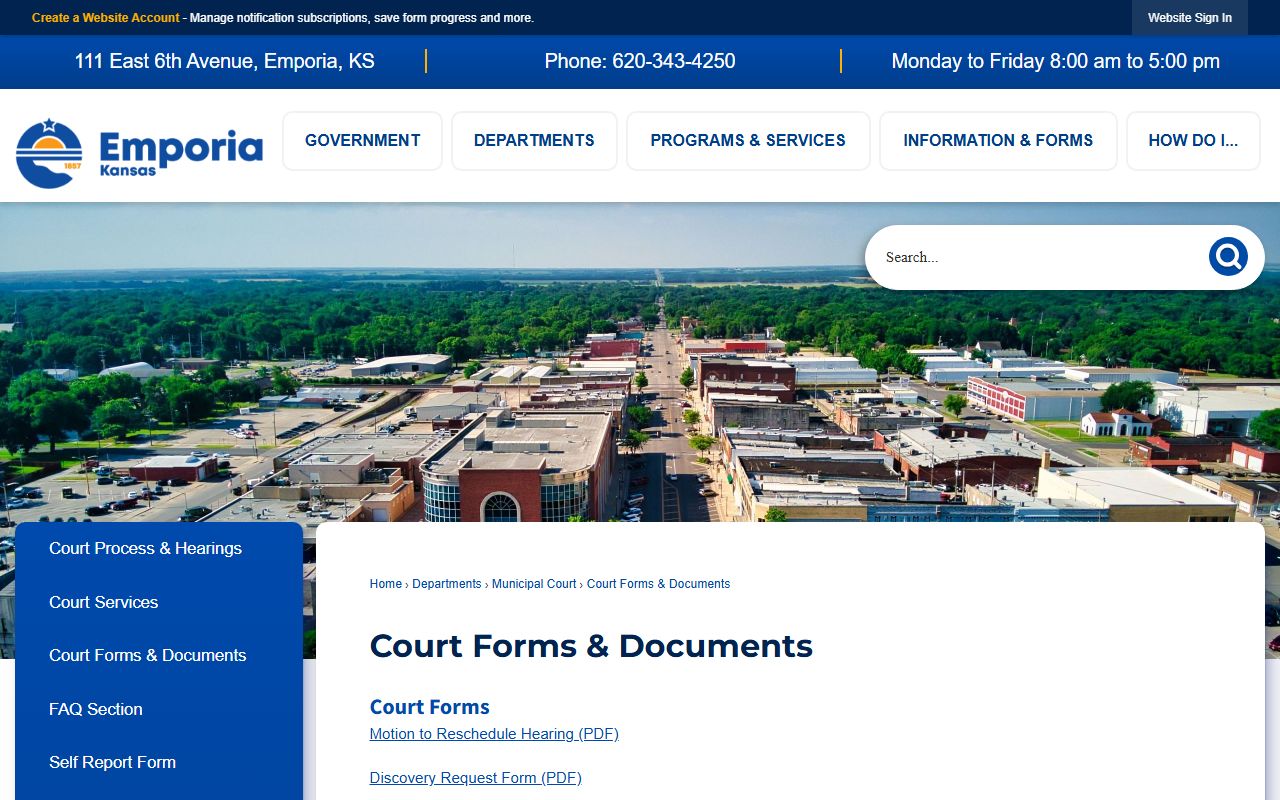
Forms do not replace the court docket, but they show the kinds of filings that may follow a charge after arrest or citation.
Search Lyon County Charge Records
For District Court charges, start with the official Kansas District Court Public Access Portal, also known as CaseSearch. Official court guidance describes it as the public path to search Kansas district court cases online. Search results may show party name, case number, filing date, case type, status, and court when the record is public. The portal will not show every record type. Domestic, juvenile, adoption, protection, guardianship, conservatorship, coroner, grand jury, expunged, sealed, and other confidential matters may be excluded or limited.
- Identify whether the incident belongs in Lyon County District Court, Emporia Municipal Court, another city court, or a custody-only system.
- Search the District Court portal by name or case number for public district criminal cases.
- For Emporia city cases, check municipal court dockets or call the Municipal Court clerk at 620-343-5666.
- Read each charge by count, statute or ordinance, level, hearing status, bond entry, and disposition if one has been entered.
- For unclear matches, contact the criminal clerk emails or the court that filed the case before relying on the record.
Kansas Open Records Act requests may help when the needed record belongs to a law enforcement agency rather than a court. K.S.A. 45-218 requires a custodian to act as soon as possible and no later than the end of the third business day, or explain a delay or denial. A request should name the agency, date, involved person, report type, and willingness to pay lawful fees.
Lyon Charge Status Terms
Charge status can change several times. A person may be arrested on one suspected offense, then charged with a different offense after prosecutor review. Counts may be added, amended, reduced, dismissed, or resolved through a plea or diversion. A docket line may also show review, arraignment, pretrial, plea, sentencing, probation revocation, or expungement hearing. Emporia Municipal Court also describes diversion as a possible court process, and Lyon County Attorney diversion forms state that acceptance is a privilege, not a right.
| Status | What It Means | Why It Matters |
|---|---|---|
| Pending | The charge has not reached final disposition. | Future hearings, motions, diversion review, or trial may still occur. |
| Amended | The filed charge changed after review or agreement. | The original arrest label may not match the current charge. |
| Reduced | A lower offense or lesser count replaced the earlier allegation. | Severity, fines, jail exposure, and collateral effects may change. |
| Dismissed | The court record shows that a count or case was ended without conviction on that count. | A dismissal is not the same as an expungement. |
| Diversion | A prosecutor agreement may dismiss charges after conditions are met. | Terms, fees, and reporting duties may still appear in records. |
Charges vs Convictions
Being charged is not the same as being convicted. A charge is an accusation filed in court. A conviction comes later, after a guilty plea, no contest plea, verdict, or other finding that supports judgment. Court records may show both charged counts and final outcomes. That difference is important for background review, employment paperwork, housing screening, licensing questions, and personal case tracking.
| Record Point | Charge | Conviction |
|---|---|---|
| Case stage | Early accusation or count filed by prosecutor or citation | Final or later result based on plea, finding, or verdict |
| Proof level | Based on filing standard and probable cause | Requires a legal basis for judgment |
| Can change | May be amended, reduced, or dismissed | May be subject to appeal, set aside, or expungement rules |
| Where it appears | Complaint, information, citation, docket, early case record | Disposition, journal entry, sentence, probation, financial records |
For statewide custody or supervision after a county case, KDOC KASPER is not a full criminal-history report. It is a corrections search and includes its own official accuracy limits. County court charge records and state correction records answer different questions.
Public Access and Limits
Kansas has an open-records premise, but court access is shaped by court rules and confidentiality law. District Court case files belong with the court system. Emporia municipal ordinance and traffic files belong with Municipal Court. Police incident and arrest reports belong with the arresting agency. Custody status belongs with the jail or VINE. A search should start with the right record holder, because no one database combines every arrest record, charge, custody status, and outcome.
The K.S.A. 22-4610 source image is included because some law enforcement records are public in a different way than court charges. It concerns biased-policing policies and annual reports, showing why police agency records should not be treated as identical to the court's criminal case file.
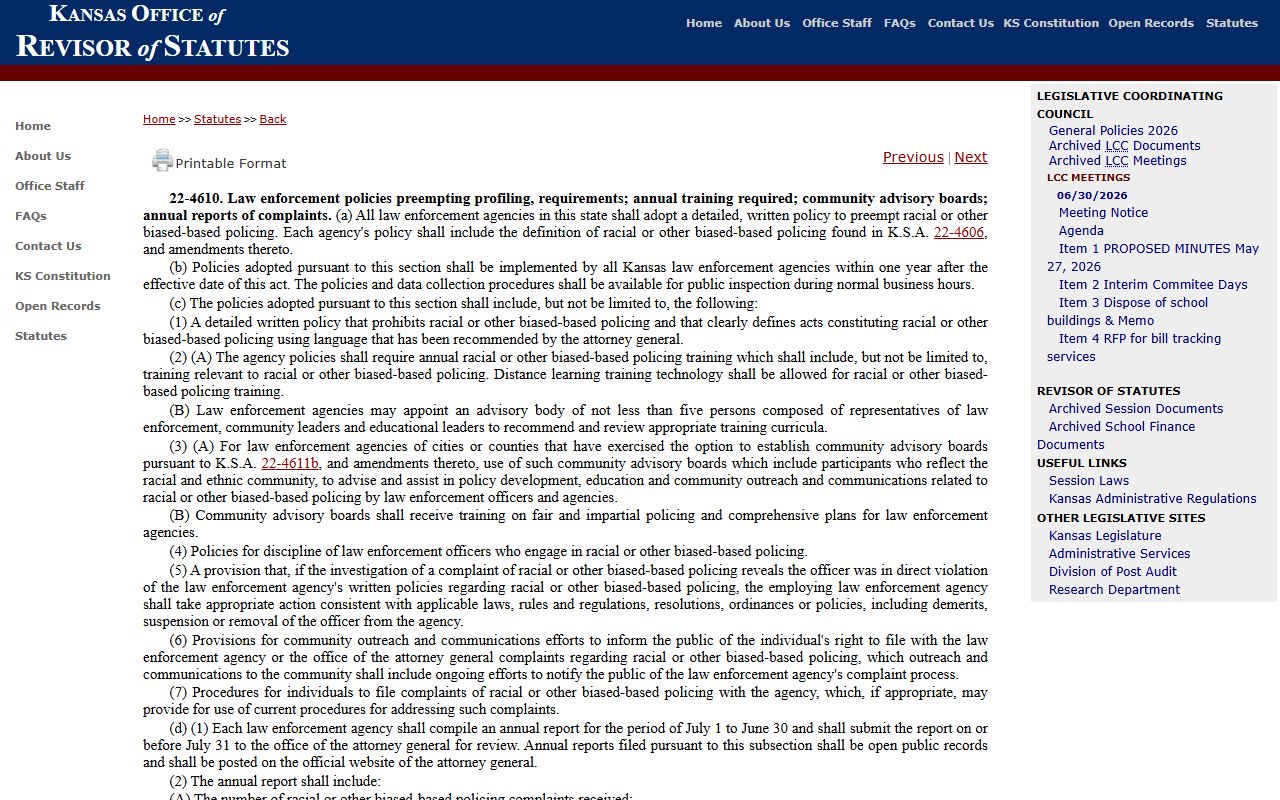
For court charge lookup, the practical rule is simple: use court systems for filed charges, law enforcement requests for agency records, and jail or VINE for custody status.
Restricted Charge Records in Lyon County
Some records will not be visible to the public even when the event is real. Official public portal guidance excludes juvenile CINC and juvenile offender cases, adoption records, care and treatment matters, protection orders, certain domestic cases, guardianship and conservatorship matters, coroner matters, grand jury matters, sealed records, and expungement records. Redactions can also remove Social Security numbers, financial account data, minor names, victim-sensitive information, medical data, and confidential addresses.
- Sealed
- Hidden from public access by rule, statute, or order. Party, attorney, agency, or court-order access may still exist.
- Expunged
- Restricted after a qualifying order. The subject and certain statutory users may still have access in defined situations.
- Juvenile
- Excluded or limited in public portal display. Access is controlled by the court and by statute.
- Active investigation
- Agency records may be withheld or redacted through a KORA response from the custodian.
Emporia Municipal Court explains that most city ordinance convictions can be eligible for expungement after a waiting period, with longer waits for certain driving and DUI-related convictions. An expungement order does not always erase every legal consequence. It can still have exceptions for future sentencing, criminal justice employment, licensing, concealed carry, commercial driving, and other statutory uses.