
Lyon County Warrant Search Limits
No official Lyon County active warrant-search database was located in the research materials. That gap is important. A user should not treat the absence of an online county warrant list as proof that a warrant does not exist. Some warrants are not posted before service. Some are tied to court files, sealed matters, juvenile records, municipal court failures to appear, or another agency. The better local method is a channel-by-channel check: Sheriff's Office, District Court, Emporia Municipal Court, jail custody status, Kansas CaseSearch for public case events, and written records requests where appropriate.
The official Lyon County Most Wanted page is a public-safety list, not a complete active-warrant search. It warns that information may not be current, that users should not act solely on the record, and that no one should attempt apprehension. During research, the page displayed a named wanted person with race, sex, eye and hair color, bond, and alleged offense. That kind of entry can be useful, but it is not the same as a searchable warrant index for all active warrants.

The Most Wanted source is best treated as a high-risk public notice. Routine bench warrants, municipal warrants, recalled warrants, and sealed warrants may need direct court or law enforcement confirmation.
Types of Lyon Warrants
Warrant language can be confusing because several court orders can lead to arrest or custody. A warrant record may identify the issuing court, case number, charge, bond, agency, or warrant type, but no official Lyon County sample warrant database was inspectable. Use the labels below as practical definitions, not a promise that every field appears in a local record.
- Arrest warrant - A court order authorizing arrest on a criminal complaint or failure to comply.
- Bench warrant - A judge-issued warrant, often for failure to appear, probation or diversion violation, or contempt.
- Search warrant - An order authorizing a search, often not public before execution.
- Municipal warrant - A warrant arising from Emporia Municipal Court for city ordinance or traffic cases.
- District court warrant - A warrant in a felony, misdemeanor, probation, or other District Court proceeding.
- Hold or detainer - A custody hold from another agency that may show in custody records but not as a local warrant list.
Emporia Municipal Court is especially important because city warrants may not be found by checking only the county sheriff website or District Court case search. The Municipal Court process page says a person can call the Court Clerk about a bench warrant and may be able to use the Tuesday walk-in docket if the matter qualifies.
How to Search Lyon County Warrants
The safest search process starts by identifying the court or agency. District criminal matters can be tied to Lyon County District Court. Emporia ordinance and traffic matters can be tied to Emporia Municipal Court. Custody after an arrest can appear through the jail or VINE. Public case events may appear in Kansas CaseSearch, but the portal should not be treated as a complete warrant lookup.
- Check the official Most Wanted page only as a public-safety list, not as a complete warrant database.
- Call the Lyon County Sheriff's Office at 620-341-3205 for sheriff records or warrant-related routing. Use 911 for emergencies.
- Call Lyon County District Court at 620-341-3283 for case or warrant questions tied to District Court proceedings.
- For Emporia city matters, call Municipal Court at 620-343-5666 and ask whether the Tuesday walk-in docket applies.
- Check jail or VINE custody status after an arrest, but do not treat custody search as an active-warrant list.
- Use a written records request to the proper custodian when the record is not available through a public portal.
| Search Channel | Starting Detail | Use | Known Limit |
|---|---|---|---|
| Sheriff online warrant search | No public form located | None verified | Do not assume a missing result clears a warrant. |
| Most Wanted page | Name or visible entry | High-risk public-safety notice | Not a full active-warrant database. |
| District Court | Name, case number, or hearing context | District criminal case and warrant questions | Some case events may be restricted. |
| Emporia Municipal Court | Name, ticket, case, or missed date | Municipal bench warrant questions | City court matters only. |
| Jail / VINE | Name or custody search | Custody after arrest | Does not list all outstanding warrants. |
Kansas open-records rules support requests to the proper records custodian, but warrant records can be withheld or limited when disclosure would affect law enforcement, public safety, sealed matters, juvenile matters, or another protected category. K.S.A. 45-218 sets the general response rule for public records, while K.S.A. 45-221 lists categories agencies are not required to disclose.
Emporia Municipal Warrants
Emporia Municipal Court provides one of the clearest local warrant paths. It handles adult misdemeanors occurring in Emporia, with exceptions, and tickets written by local city and campus agencies. Its process material says a person can call the Court Clerk at 620-343-5666 to ask about a bench warrant, turn themselves in at the Lyon County Detention Center when appropriate, or appear at the Tuesday walk-in docket if the matter is eligible.
| Municipal Option | Details | Limits |
|---|---|---|
| Call the clerk | 620-343-5666 for Emporia Municipal Court warrant questions | City cases only, not all county warrants |
| Walk-in docket | Tuesdays when court is in session, 10:00 a.m. to 10:30 a.m. | Sign in by 9:45 a.m.; first 10 defendants; unrepresented defendants only |
| Detention Center surrender | May be appropriate for some bench warrant situations | Call court or counsel first when possible |
| Not eligible | Arraignments, expungements, diversion questions, pretrial hearings, plea hearings, revocations, trials, and sentencings | Those matters require the assigned court process |
This municipal path is a major Lyon County detail. A person with an Emporia ticket or ordinance case may have a city bench warrant even if a county-level web search returns nothing useful.
Lyon Warrant Record Fields
No official searchable Lyon County warrant database was inspectable, so no verified local search-field table exists for active warrants. The field inventory below is conservative. It reflects what a released warrant record commonly may include and should not be read as a guarantee that the Sheriff's Office, District Court, or Municipal Court will release each item in every case.
| Field | What It May Show |
|---|---|
| Name | Person named in the warrant or wanted notice. |
| Warrant number | Internal warrant identifier if released by the agency or court. |
| Case number | District, municipal, or other court case tied to the warrant. |
| Issuing court | District Court, Municipal Court, or another issuing court. |
| Charge or offense | Underlying criminal, traffic, ordinance, probation, or contempt matter. |
| Bond amount or type | Any bond condition listed for release or appearance. |
| Issue date | Date the warrant was issued, if public and released. |
| Agency | Law enforcement office or court responsible for the record. |
Most Wanted entries can contain a smaller visible field set. Court docket entries may show a warrant event without giving a full warrant image. Jail records may show that a person is in custody after service, but not list all outstanding warrants.
Tips and P3 Channels
The Sheriff's research identified a tip path through Lyon County Crime Stoppers and official-linked P3 Tips channels. Crime Stoppers phone is 620-342-2273. A tip channel is for reporting information, not for clearing your own warrant or confirming whether a warrant exists. If there is immediate danger, call 911. If a person believes they are wanted, they should call the issuing court, the Sheriff's Office, or counsel rather than submitting a tip about themselves.
The official tip page capture failed in the manifest, so no image from that source is used here. The page remains a valid research source for the P3 and tips discussion, but only successful manifest images are displayed.
If a Warrant Exists
An outstanding warrant should be handled through the court that issued it. Ask whether the case can be placed on a docket, whether a bond is set, whether payment alone is enough, whether counsel may appear, and whether surrender is required. Do not rely on a general web search to make the decision. A warrant may have been issued, recalled, sealed, transferred, or tied to a municipal file that does not appear in the place searched.
Important: Call the issuing court or a lawyer before appearing at the jail when time and safety allow.
After a warrant is resolved, ask when the warrant recall or clearance will update in court and law enforcement systems. Updates may not be instant. Keep proof of payment, appearance, recall order, bond paperwork, or dismissal. For Emporia municipal matters, the walk-in docket can address warrants, payment agreement modifications, and advancement or continuance requests, but it does not cover every hearing type.
People checking for someone else should avoid direct contact or self-help. The official Most Wanted warning is clear that no one should attempt apprehension. Use the Sheriff's Office, the court clerk, Crime Stoppers, or emergency dispatch as the situation requires.
Restricted Warrant Records
Warrant records can be restricted for sound reasons. Search warrants may remain confidential before execution. Juvenile matters are not public in the same way adult criminal records are. Sealed and expunged records may be withheld from the public. Active investigations can also limit release from a law enforcement agency. Kansas courts and agencies must balance public access with safety, privacy, court rules, and statutory exceptions.
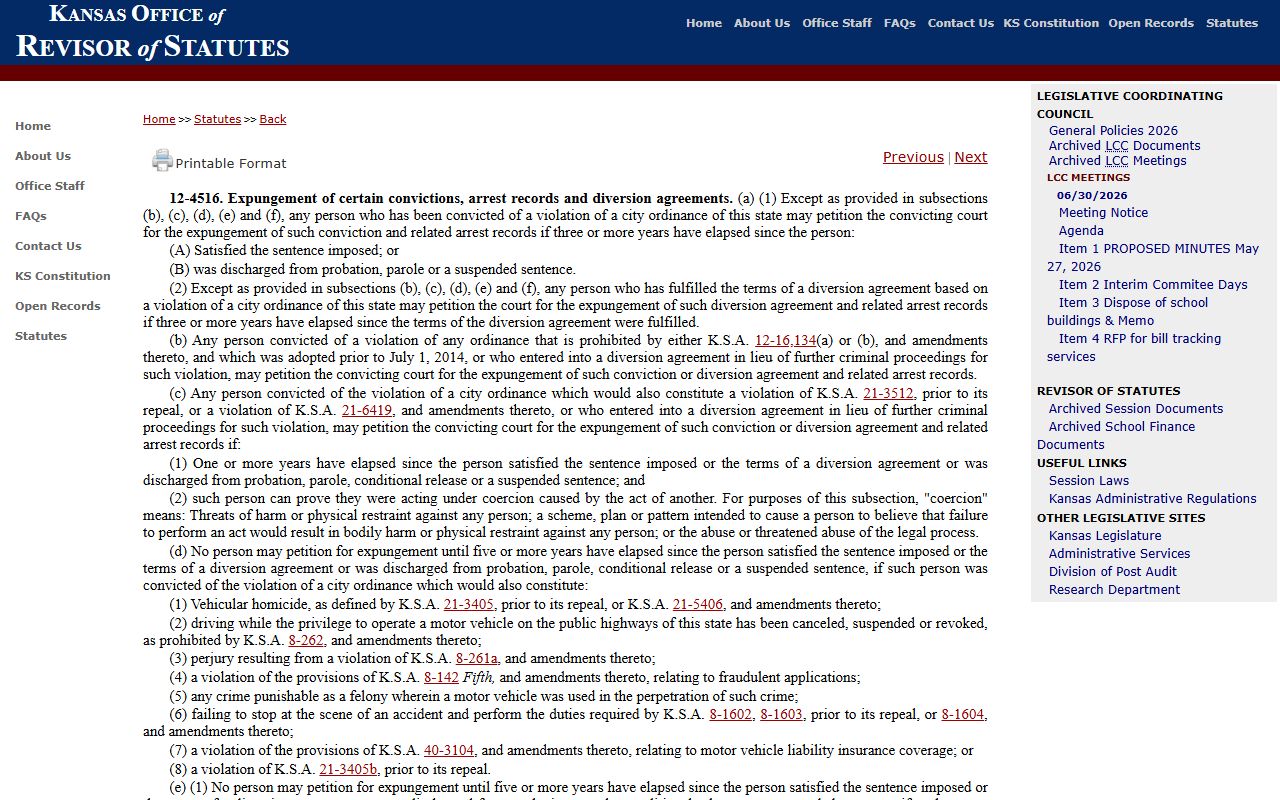
The K.S.A. 12-4516 source image is included because municipal expungement can affect city records after a case is resolved. Expungement is not a warrant-search tool, but it helps explain why old municipal arrest, conviction, or diversion records may not remain broadly public.
When a record is restricted, the right next step is usually a direct request to the custodian or a court filing, not a broader internet search.